- pricing
- web development
- next.js
How Much Does a Next.js Website Cost?
A straight answer on website pricing — what each price range actually buys you, where the money goes, and how to tell if a quote is fair.

Md Ariful Islam
5 min read
Nobody in this industry wants to talk about price.
You ask an agency what a website costs. They say "it depends on your requirements" and book you a call. You get on the call, answer forty questions, and two weeks later a PDF arrives with a number on it. You have no idea if that number is fair, because you have nothing to compare it to.
So here's the thing nobody publishes: what websites actually cost, and what you get at each level.
I'll be upfront — these are my numbers, based on my own work and quotes I've seen. Another developer will give you different figures. But the shape of it holds everywhere.
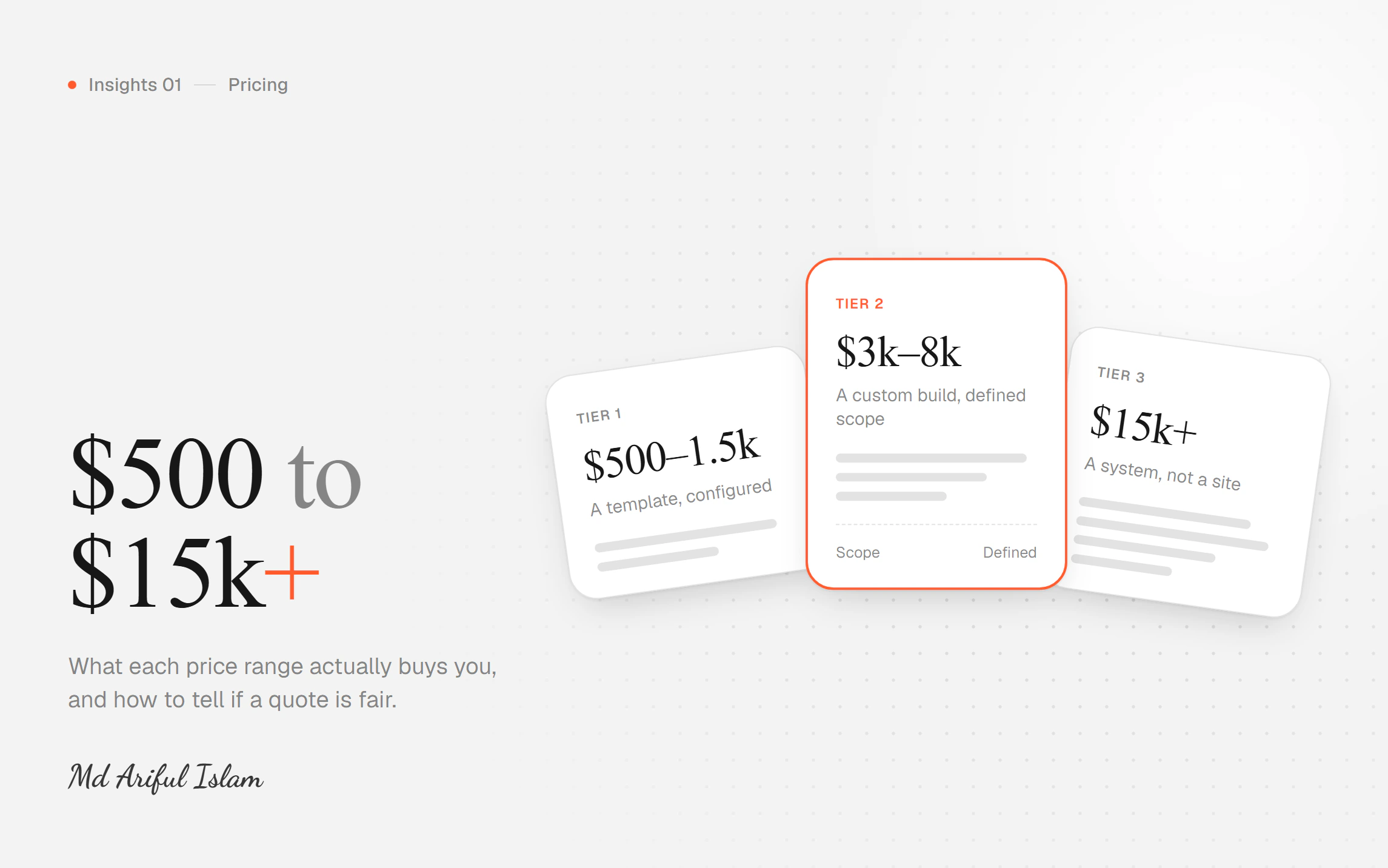
Tier 1: $500 – $1,500
What you get: a template, configured.
Someone buys a ready-made theme, swaps in your logo, drops in your text, and hands it over. Sometimes they design a little on top of it.
When this is the right call:
You need a website to exist. People look you up, they need to find your phone number and a sense of what you do. Nobody's buying anything on the site. You update it twice a year.
That's a real situation, and paying more than $1,500 for it is a waste.
What you should know:
Templates ship with every feature the template author imagined — sliders you'll never use, animation libraries for one hover effect, three font families. All of it downloads to every visitor's phone whether you use it or not. That's why template sites are usually slow.
You'll also hit a wall. The day you need something the template didn't plan for, you're stuck. Changing it costs more than building it properly would have.
Tier 2: $3,000 – $8,000
What you get: a custom build with a defined scope.
Someone builds the specific thing your business needs. Real framework, proper structure, and a content system your team can actually use without calling a developer.
When this is the right call:
Your website does a job. It generates leads, or it sells something, or it's how customers understand what you offer. You publish content. You'd notice if it went down.
This is where most small and mid-sized companies belong, and where most of them underspend.
Where the money actually goes:
| Roughly | On what |
|---|---|
| 15% | Working out what to build and measuring what exists now |
| 25% | Design, or adapting your existing brand |
| 45% | Building it |
| 15% | Testing, launching, documentation, handover |
If a quote in this range has no line for the first item or the last, be careful. Projects that skip measurement can't prove they worked. Projects that skip handover become expensive in year two.
The warning:
This tier fails when the scope isn't written down. The same project with a vague scope becomes a Tier 3 project on a Tier 2 budget, and then everyone is unhappy. More on that below.
Tier 3: $15,000 and up
What you get: a system, not a site.
Many page types, integrations with other software, a design system so future pages stay consistent, performance budgets, usually more than one person working on it.
When this is the right call:
Your website is the business, or close to it. E-commerce doing real volume. A SaaS product with a marketing site that has to convert. A company where a day of downtime is a meeting with your boss.
When it's not:
If your site's main job is helping people find your phone number, this is a very expensive phone number.
The question that decides your tier
Not "how big is my company." This one:
What happens to the business if the website works better?
If you can't answer it, you're in Tier 1 territory — and that's fine, it just means don't spend Tier 2 money.
If the answer is "we'd stop losing enquiries on mobile" or "we'd convert 15% more of the traffic we already pay for," you can work out what a fix is worth, and the budget answers itself.
Why quotes vary so much for the same job
Four honest reasons, and one dishonest one.
Scope. "A website" can mean five pages or fifty. Ask what's included, page by page.
Who's doing it. A senior developer working alone costs less than an agency with a project manager, a designer and an account handler. The agency isn't ripping you off — you're paying for coordination. Whether you need coordination is the real question.
Where they are. Rates differ enormously by country. I'm in Bangladesh and I price accordingly. This is the single biggest variable in most quotes.
What's not in the quote. Content writing, photography, ongoing hosting, maintenance. Ask which of these you're expected to handle.
And the dishonest one: some quotes are priced on what the seller thinks you can pay, not what the work takes. The tell is a quote with no breakdown. Always ask for one.
Four things that make a project cost more than quoted
These are not technical. Every one of them is a decision nobody made at the start.
-
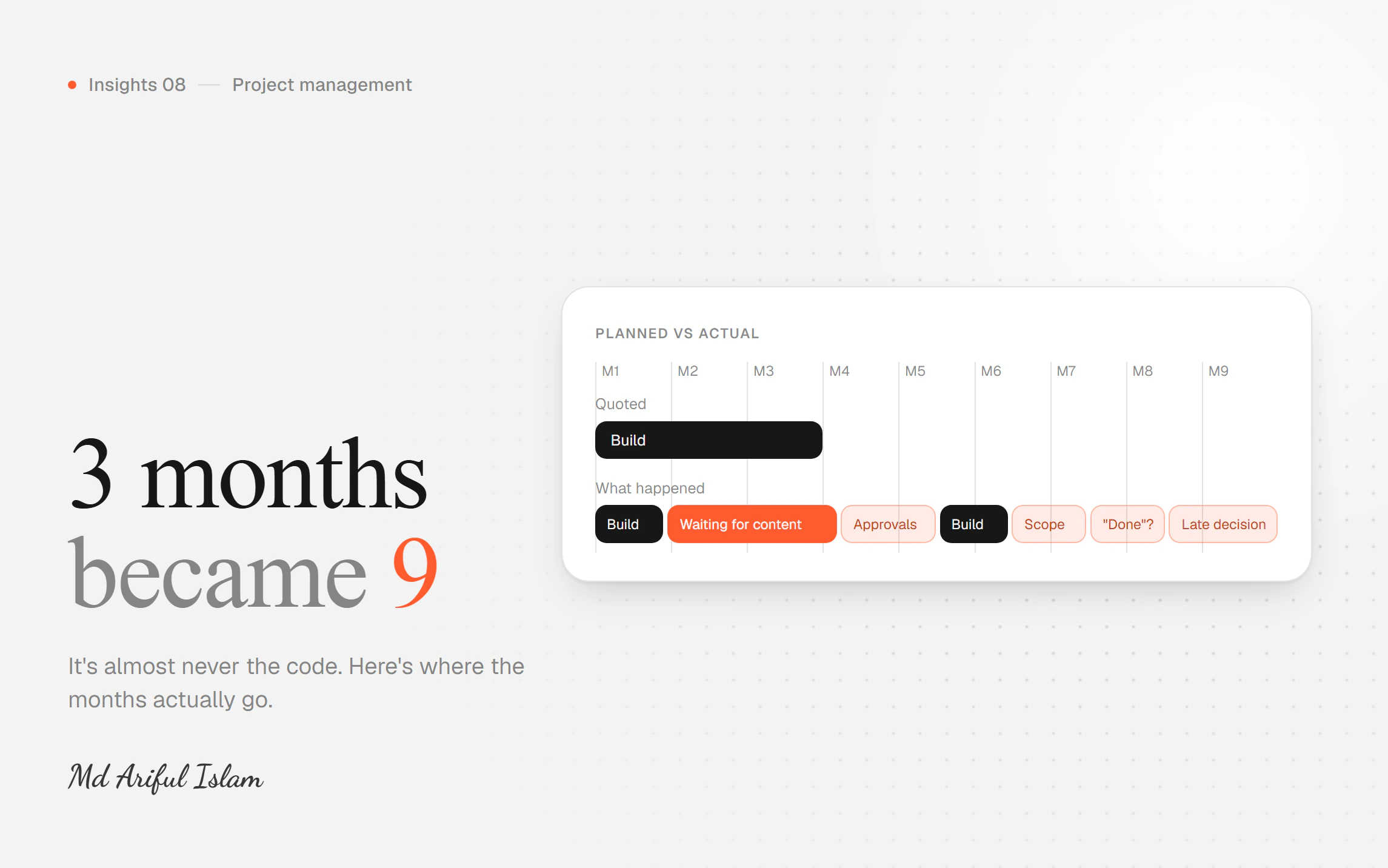
Nobody was assigned to write the content. This is the biggest cause of overruns, by a distance. The quote assumed copy arrives in week two. It arrives in week nine.
-
Too many people approve things. Two decision-makers is normal. Five means every round of feedback has to survive five sets of preferences.
-
Scope arrives quietly. Not "let's add a shop" — that gets noticed. It's "just one more page," eleven times.
-
Nobody agreed what finished means. Without a definition, a project ends when everyone gets tired. That date isn't on any plan.
What I'd ask before signing anything
- What will you measure before you start?
- What's the smallest version of this that's still worth doing?
- Who owns the code and where does it live?
- What happens if you're unavailable in month eight?
- What would you tell me not to do?
That last one matters most. Someone who agrees with every idea you have is selling. Someone who talks you out of one is thinking.
If you're weighing up a quote and want a second opinion, send me the URL of your current site. I'll tell you what I'd actually do with it — whether or not you hire me.