- redesign
- strategy
- buyers guide
You Probably Don't Need a Redesign
Most companies asking for a redesign need the site they already have to work. Here's how to tell the difference before you spend five figures.

Md Ariful Islam
4 min read
I've talked people out of redesigns. It's a worse quarter for me and a better year for them.
Here's the pattern. A company decides the website is the problem. The website does look a bit tired. So they budget for a redesign — three months, five figures — and at the end they have a nicer-looking site with the same underlying problem.
Because the complaint was never really about how it looked.
The trick is to say the complaint out loud
Whatever is bothering you about your site, put it in one sentence. Then find it below.
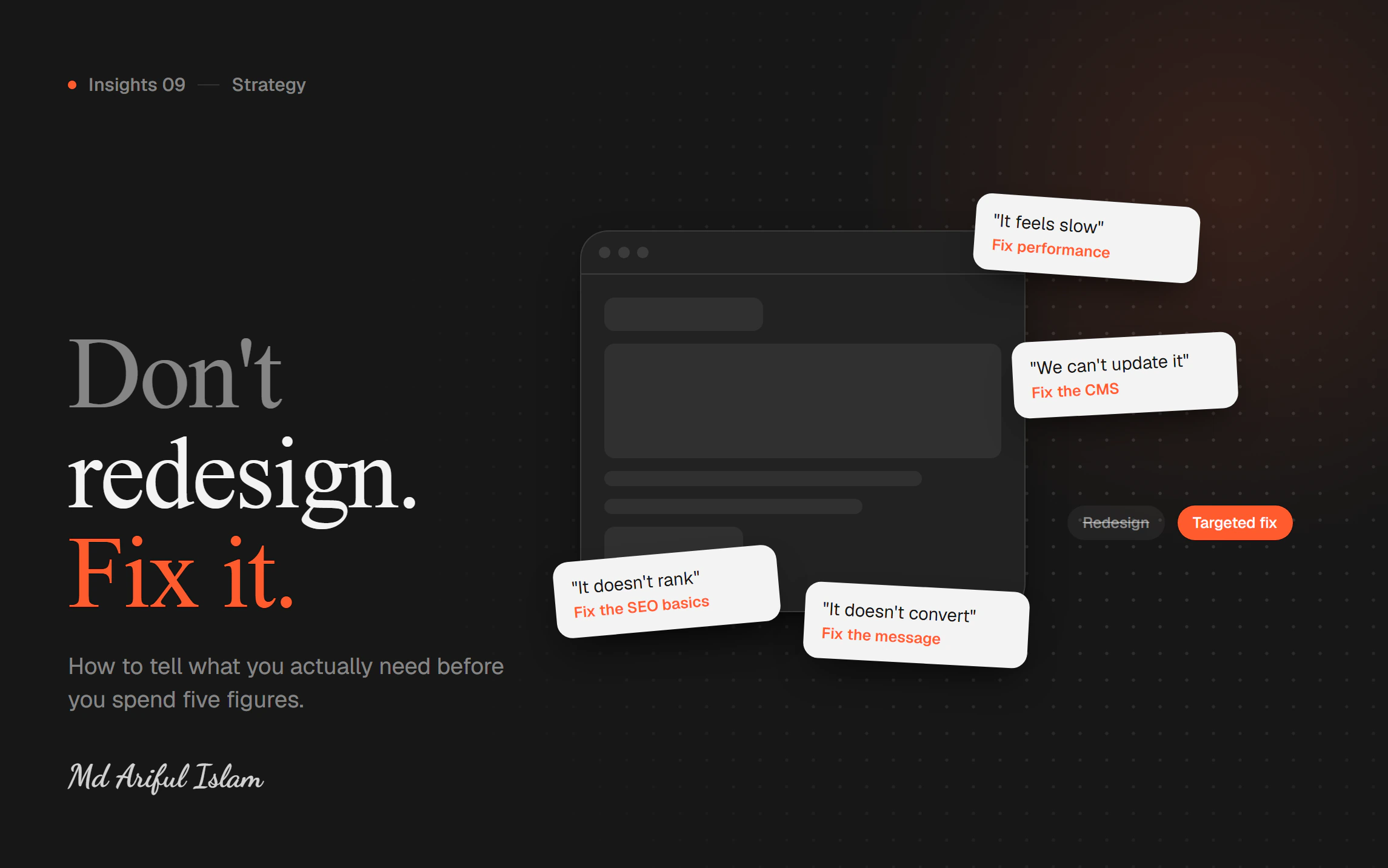
"It feels slow"
That's an engineering problem, not a design problem.
A new design on the same architecture will be slow in a prettier way. Often slower, because new designs tend to add bigger images and more animation.
What you actually need: someone to find out why it's slow. Usually oversized images, late-loading fonts, or a page that's assembled in the visitor's browser instead of prepared in advance.
Realistic cost: days, not months.
"We can't update it"
That's a content system problem.
A redesign doesn't give your marketing team access. You'll have a new site you still can't edit.
What you actually need: either a proper content system, or a fix to the one you have. Sometimes it's a permissions setting nobody ever configured.
"It doesn't rank on Google"
That's content and structure, and a redesign can make it worse.
New designs often break existing URLs, which loses whatever ranking you'd built. I've seen redesigns cut organic traffic in half on launch day.
What you actually need: find out whether the problem is technical (pages not indexed, too slow, broken structure) or editorial (nothing worth ranking for). Fix that. If you do redesign, map every old URL to a new one before launch.
"It looks dated"
Sometimes genuinely true. Often it means something smaller.
Inconsistent spacing. No clear hierarchy — everything the same size, so nothing stands out. Four font styles. Three shades of blue. Buttons that all look equally important.
Those are days of work, not a rebuild. A real type scale, one accent colour, consistent spacing — the site stops looking dated without anyone redrawing it.
"It doesn't convert"
Worth testing before rebuilding.
Move the call to action. Rewrite the headline to say what you do instead of sounding impressive. Cut the form from nine fields to three.
A redesign is the most expensive way to test a hypothesis you could test next week.
When a redesign genuinely is the answer
Your message is wrong. You've changed who you sell to, what you sell, or how you explain it. The site is arguing for a company you no longer run. No amount of speed fixes that.
You've outgrown the structure. You had three services, now you have twelve. Pages have been bolted on for years and the navigation is a maze. That's structural.
It genuinely doesn't work on phones. Not "looks a bit cramped" — actually broken. If your site predates responsive design, a rebuild is honest.
You're about to make a lot of new pages. If you're going from 10 pages to 100, building a proper system first is cheaper than doing it later.
A better order of operations
-
Measure. Load time, where people leave, what they click, how you rank. A week's work, and it usually surprises people.
-
Write down the one number you want to change. One. Not three.
-
List the cheapest things that might move it. Almost always: speed, headline, and the call to action.
-
Do those first. Weeks, not months.
-
Then decide. If the number moved, you just saved a lot of money. If it didn't, you now have evidence that the problem is deeper — and you'll brief the redesign far better than you would have.
What this costs when you get it wrong
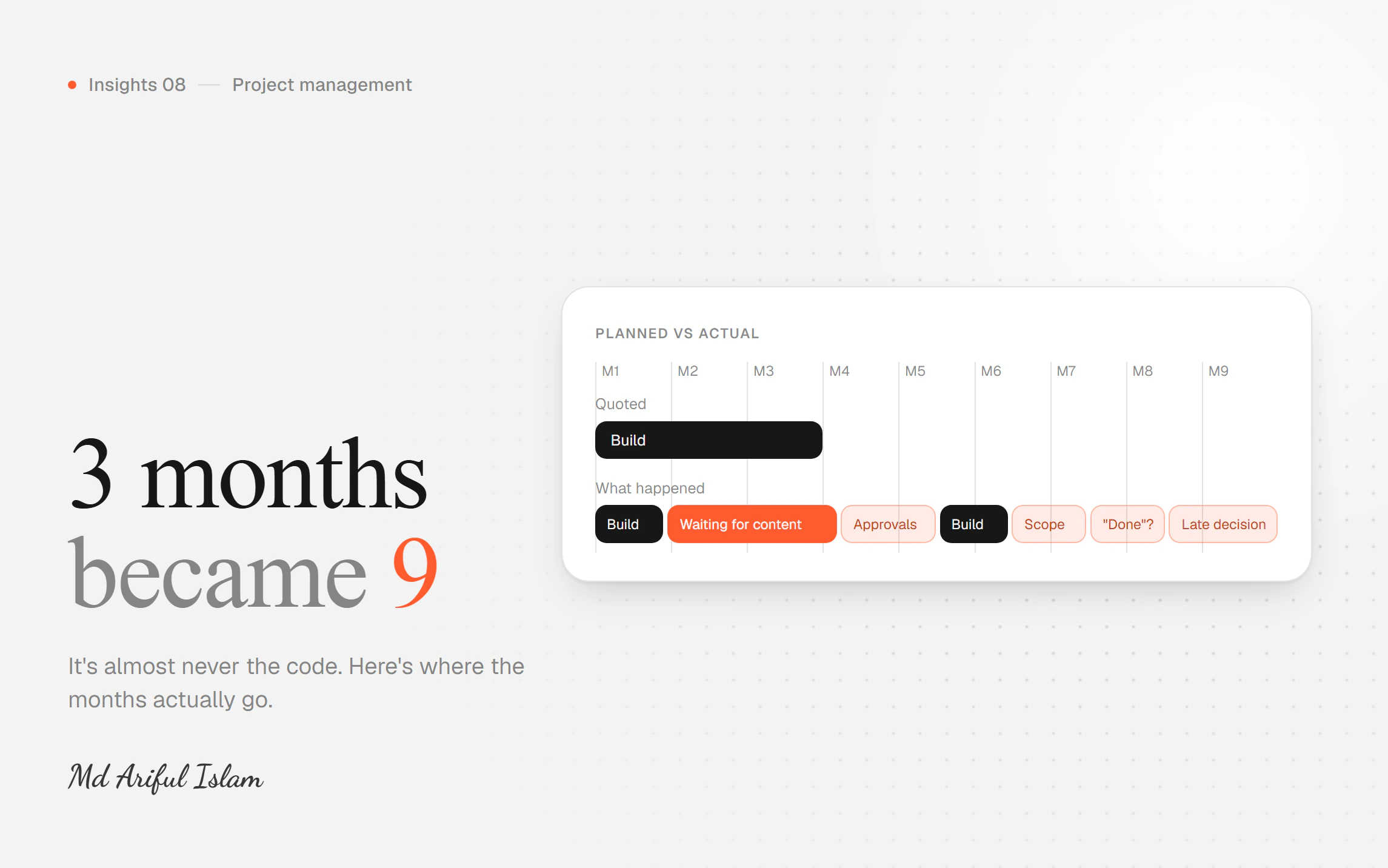
I worked on a site whose owner was certain they needed a redesign. Their complaint was that it felt slow and tired.
We measured first. The design wasn't the problem — the pages took 3.5 seconds on mobile, mostly oversized images and content being fetched in the browser instead of prepared in advance.
We rebuilt what was underneath and left the look largely alone. Load time went to 0.9 seconds. Same copy, same images, same brand.
The redesign they were about to commission would have cost several times more and probably wouldn't have fixed the actual complaint.
The most expensive thing in a web project is solving the wrong problem beautifully.
Measure before you redesign — even if you hire someone else to do the work. If you want a second opinion on whether yours needs rebuilding, send me the URL and the one-sentence version of your complaint.